Electricity is where the story begins, not where it ends. What matters is what people are able to do once the lights stay on.
Walk through Ariaria Market in Aba on any weekday and you will hear the case for infrastructure more clearly than any policy paper can make it. It is in the whirr of sewing machines, the tapping of shoemakers’ hammers and, for years, the steady drone of generators that traders learned to live with. Every one of those generators is a cost the business carries: in fuel, in maintenance, and in environmental pollution and its associated health hazards. These eventually impact the price each seller sets for his or her items and services in order to break even and survive.
When power becomes reliable, that cost begins to drop significantly. A small, medium or large-scale manufacturer can accept more orders. A cold room can safely keep stock overnight. A clinic can plan its day and attend to medical emergencies that save lives without watching the fuel gauge.
That is why I have never thought of our work at Geometric Power as simply the supply of electricity. Our generation of electricity (in megawatts) is the means to an end. The end is what people are able to do with the electricity they receive.
However, this also raises a harder question for anyone in leadership: once the asset is built, what else must be built around it for the value to be sustained? From my decades of corporate management experience, I believe that the correct answer is primarily the people and the systems that organisations and institutions put in place to identify and utilise the opportunities.
Measure the Power by What It Makes Possible
A power plant, a road or a hospital is not an end in itself. Its worth lies in the activities it makes possible.
Reliable electricity lowers the cost and uncertainty of doing business. It gives investors a reason to stay, gives essential services room to plan and allows communities to take a fuller part in the economy. Yet the projects that deliver the most are those designed around the people and enterprises they serve, not around engineering specifications alone.
Aba businesses and residents understood this long before we arrived. Aba is a commercial city of makers. Its residents and businesses include manufacturers, artisans and traders whose ingenuity has often run ahead of the infrastructure around them. Powering a city like this is a partnership with the people whose work creates jobs, sustains families and carries the name “Made in Aba” well beyond Nigeria’s borders.
The principle of being an enabler travels far beyond the power sector. Development should be judged by how much it enlarges opportunity for others.
What Happens After the Ribbon Is Cut
Big projects win the headlines. The ribbon is cut, the photographs are taken and attention moves on. What rarely makes the news is the quiet institutional work that decides whether the project is still performing ten years later.
That work is unglamorous. It means making sound decisions, being clear about who is responsible for what, managing resources carefully and holding standards when leaders change or circumstances become difficult. It requires governance that works, accountability that is real and a culture that values learning as much as performance.
It also takes patience. Institutions are not built by announcement. They are built by habit: keeping accurate records, developing people, confronting problems honestly and improving systems a little at a time.
Where institutions are weak, even large investments underperform, and every new leader starts again from the beginning. Where institutions are strong, each generation builds on what the last one left behind.
So, the question I put to our team and any system we create is a simple one: will it still be useful, trusted and effective long after the people who built it have moved on?
Machines Don’t Run Themselves
Equipment can be bought. Technology can be installed. Processes can be written down. None of it runs itself.
Every organisation ultimately depends on people who can exercise good judgement, solve problems, work with others and take ownership of outcomes. The quality of execution will never rise above the capability and commitment of the people doing the work.
I see this from two vantage points. At our power development company, Geometric Power, I see what technical competence, coordination and operational discipline make possible in a complex system. At our vocational training institute, Dewdrop Institute, I see what happens when a young person receives practical, well-designed training: potential becomes productive work, often faster than anyone expected.
These are two sides of the same challenge. Businesses need capable people. Young people need credible pathways into work. Communities need institutions that can turn talent into opportunity. None of these gaps will close unless employers, training institutions, government and society work on them together.
Results First, But Never Results Alone
Let me be clear about the order of things. A business’s first duty is to perform: to deliver value, use resources responsibly and remain sustainable. Good intentions are no substitute for sound management.
But no serious business stands apart from its society. It shapes employment, skills, supply chains and professional standards, and, perhaps most importantly, the confidence a community has in its own future.
Responsible leadership therefore holds two questions at once. Are we delivering results? And are those results building something that will last?
No single organisation can solve every problem, and pretending otherwise helps no one. What we can do is be deliberate about what lies within our reach. We can train people properly. We can insist on ethical work. We can make room for young professionals to grow. And we can build partnerships on shared responsibility rather than short-term visibility.
Progress Runs on Trust
Powering progress means more than the electricity that flows through a network.
It means the confidence to invest, the skills to participate, the institutions that sustain performance and the opportunities that let people improve their own lives. The foundation on which all of these are built is “TRUST”: the assurance that tomorrow’s supply will be as dependable as today’s, and that effort will be rewarded.
Nigeria needs infrastructure; there is no question about that. But it also needs organisations that work, leaders who take the long view and people equipped to turn investment into results.
That is the work before all of us who aspire to be good leaders: to build physical capacity and human capacity side by side, to pursue growth that creates opportunity and to measure progress not only by what we construct, but by what people are able to do because it exists.
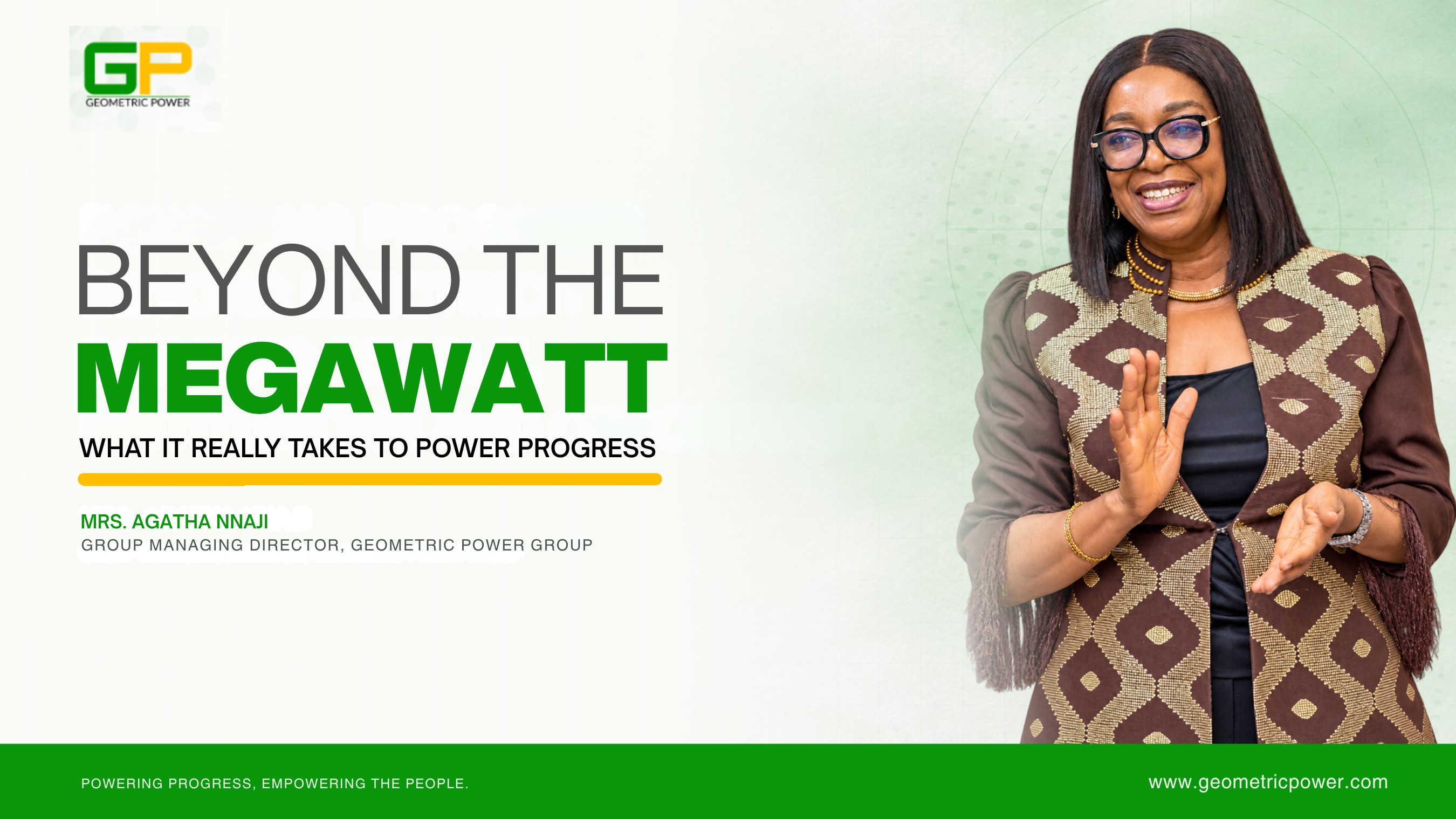
Mrs. Agatha Nnaji is Group Managing Director of Geometric Power Group.